
Scaling Research Through a Centralised System
Scaling Research Through a Centralised System
Scaling Research Through a Centralised System
Role: UX Strategist |· Focus: Research Systems, DesignOps, Knowledge Management
Role: UX Strategist
Role: UX Strategist |· Focus: Research Systems, DesignOps, Knowledge Management
Transforming fragmented research into a structured, accessible, and collaborative system.
Transforming fragmented research into a structured, accessible, and collaborative system.
Transforming fragmented research into a structured, accessible, and collaborative system.

I was tasked with creating a centralised repository on Confluence to house and manage UX research findings and documentation.
At the time, research outputs were stored as PowerPoint presentations on SharePoint, making them difficult to locate, reuse, or build upon. As a result, valuable insights were often lost, duplicated, or underutilised across projects.
While the initial request focused on creating a repository, it quickly became clear that the underlying challenge was broader; the organisation lacked a structured and scalable approach to managing and leveraging research.
This shifted the focus from simply storing research to designing a system that could:
Make insights more visible and accessible
Support collaboration across teams
Feed into foundational artefacts such as personas, journey maps, and strategic outputs
This was a solo project, where I led the work end-to-end across strategy, research, and design.
Project Overview
Project Overview
I was tasked with creating a centralised repository on Confluence to house and manage UX research findings and documentation.
At the time, research outputs were stored as PowerPoint presentations on SharePoint, making them difficult to locate, reuse, or build upon. As a result, valuable insights were often lost, duplicated, or underutilised across projects.
While the initial request focused on creating a repository, it quickly became clear that the underlying challenge was broader; the organisation lacked a structured and scalable approach to managing and leveraging research.
This shifted the focus from simply storing research to designing a system that could:
Make insights more visible and accessible
Support collaboration across teams
Feed into foundational artefacts such as personas, journey maps, and strategic outputs
This was a solo project, where I led the work end-to-end across strategy, research, and design.
I was tasked with creating a centralised repository on Confluence to house and manage UX research findings and documentation.
At the time, research outputs were stored as PowerPoint presentations on SharePoint, making them difficult to locate, reuse, or build upon. As a result, valuable insights were often lost, duplicated, or underutilised across projects.
While the initial request focused on creating a repository, it quickly became clear that the underlying challenge was broader; the organisation lacked a structured and scalable approach to managing and leveraging research.
This shifted the focus from simply storing research to designing a system that could:
insights more visible aMakend accessible
Support collaboration across teams
Feed into foundational artefacts such as personas, journey maps, and strategic outputs
This was a solo project, where I led the work end-to-end across strategy, research, and design.
Project Overview
I was tasked with creating a centralised repository on Confluence to house and manage UX research findings and documentation.
At the time, research outputs were stored as PowerPoint presentations on SharePoint, making them difficult to locate, reuse, or build upon. As a result, valuable insights were often lost, duplicated, or underutilised across projects.
While the initial request focused on creating a repository, it quickly became clear that the underlying challenge was broader; the organisation lacked a structured and scalable approach to managing and leveraging research.
This shifted the focus from simply storing research to designing a system that could:
insights more visible aMakend accessible
Support collaboration across teams
Feed into foundational artefacts such as personas, journey maps, and strategic outputs
This was a solo project, where I led the work end-to-end across strategy, research, and design.

My Role
My Role
I led the project end-to-end, defining the strategy, conducting research, and designing the solution.
My responsibilities included:
Framing the problem and identifying the broader opportunity
Conducting stakeholder and user research
Defining the information architecture and overall system structure
Designing and prototyping the microsite experience
Validating concepts through testing and iterating based on feedback
Aligning the solution with stakeholder needs and existing workflows
I led the project end-to-end, defining the strategy, conducting research, and designing the solution.
My responsibilities included:
Framing the problem and identifying the broader opportunity
Conducting stakeholder and user research
Defining the information architecture and overall system structure
Designing and prototyping the microsite experience
Validating concepts through testing and iterating based on feedback
Aligning the solution with stakeholder needs and existing workflows
I led the project end-to-end, defining the strategy, conducting research, and designing the solution.
My responsibilities included:
Framing the problem and identifying the broader opportunity
Conducting stakeholder and user research
Defining the information architecture and overall system structure
Designing and prototyping the microsite experience
Validating concepts through testing and iterating based on feedback
Aligning the solution with stakeholder needs and existing workflows
My Approach
My Approach
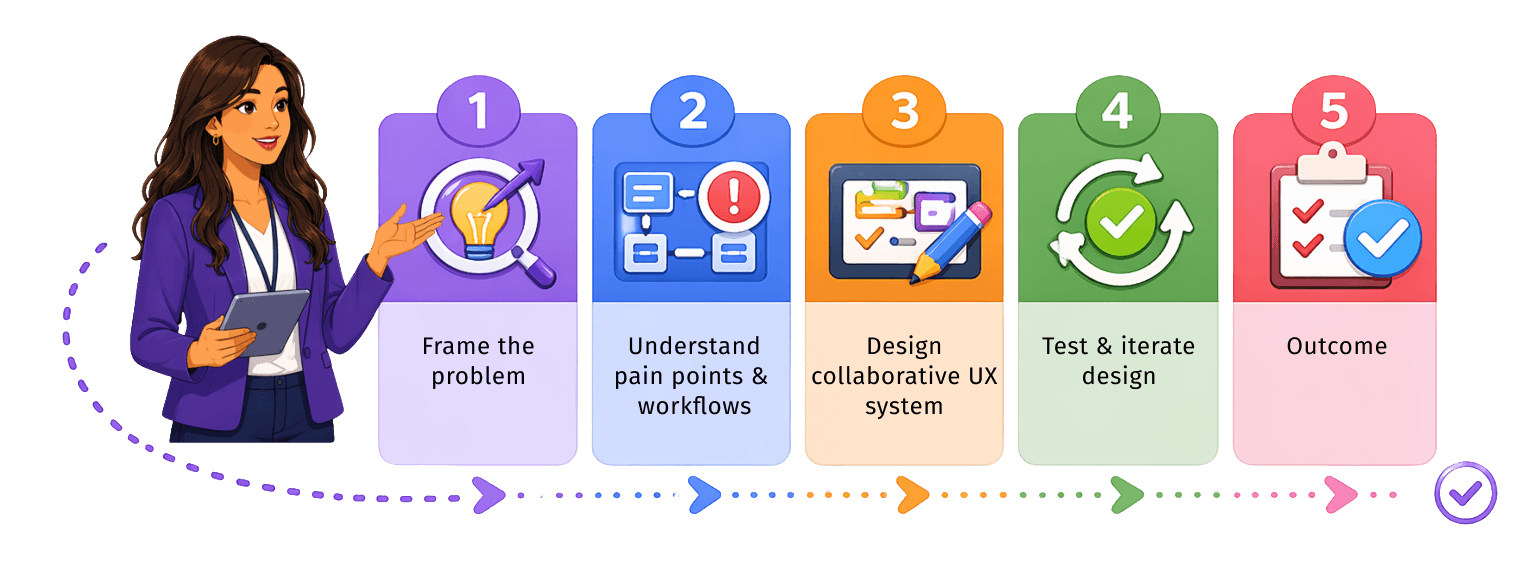
While the initial request focused on creating a repository, the approach evolved into designing a scalable system for managing and leveraging UX knowledge.
The focus shifted to understanding how research is created, used, shared, and reused across teams, then designing a solution that improves visibility, collaboration, and the long-term value of insights.
While the initial request focused on creating a repository, the approach evolved into designing a scalable system for managing and leveraging UX knowledge.
The focus shifted to understanding how research is created, used, shared, and reused across teams, then designing a solution that improves visibility, collaboration, and the long-term value of insights.
Framing the problem and opportunity
Framing the problem and opportunity
Early conversations with stakeholders revealed that the challenge extended beyond storing research; there was no structured way to connect insights across projects or make them easily accessible.
This reframed the problem from a documentation issue to a capability gap in how research was managed and utilised across the organisation.
The opportunity was to design a system that not only houses research but enables it to drive broader UX and business outcomes.
Early conversations with stakeholders revealed that the challenge extended beyond storing research; there was no structured way to connect insights across projects or make them easily accessible. This reframed the problem from a documentation issue to a capability gap in how research was managed and utilised across the organisation.
The opportunity was to design a system that not only houses research but enables it to drive broader UX and business outcomes.
Early conversations with stakeholders revealed that the challenge extended beyond storing research; there was no structured way to connect insights across projects or make them easily accessible.
This reframed the problem from a documentation issue to a capability gap in how research was managed and utilised across the organisation.
The opportunity was to design a system that not only houses research but enables it to drive broader UX and business outcomes.
Understanding workflows and pain points
Understanding users & business

Stakeholder and user interviews were conducted to understand how research was currently documented, stored, and accessed. Reviewing existing SharePoint structures highlighted key issues; research was buried within large volumes of content, difficult to locate, and rarely reused. These insights defined the need for a more accessible, structured, and user-friendly system aligned with existing ways of working.
Stakeholder and user interviews were conducted to understand how research was currently documented, stored, and accessed.
Reviewing existing SharePoint structures highlighted key issues; research was buried within large volumes of content, difficult to locate, and rarely reused.
These insights defined the need for a more accessible, structured, and user-friendly system aligned with existing ways of working.
Stakeholder and user interviews were conducted to understand how research was currently documented, stored, and accessed. Reviewing existing SharePoint structures highlighted key issues; research was buried within large volumes of content, difficult to locate, and rarely reused. These insights defined the need for a more accessible, structured, and user-friendly system aligned with existing ways of working.
Designing a scalable UX ecosystem
Redefining IA
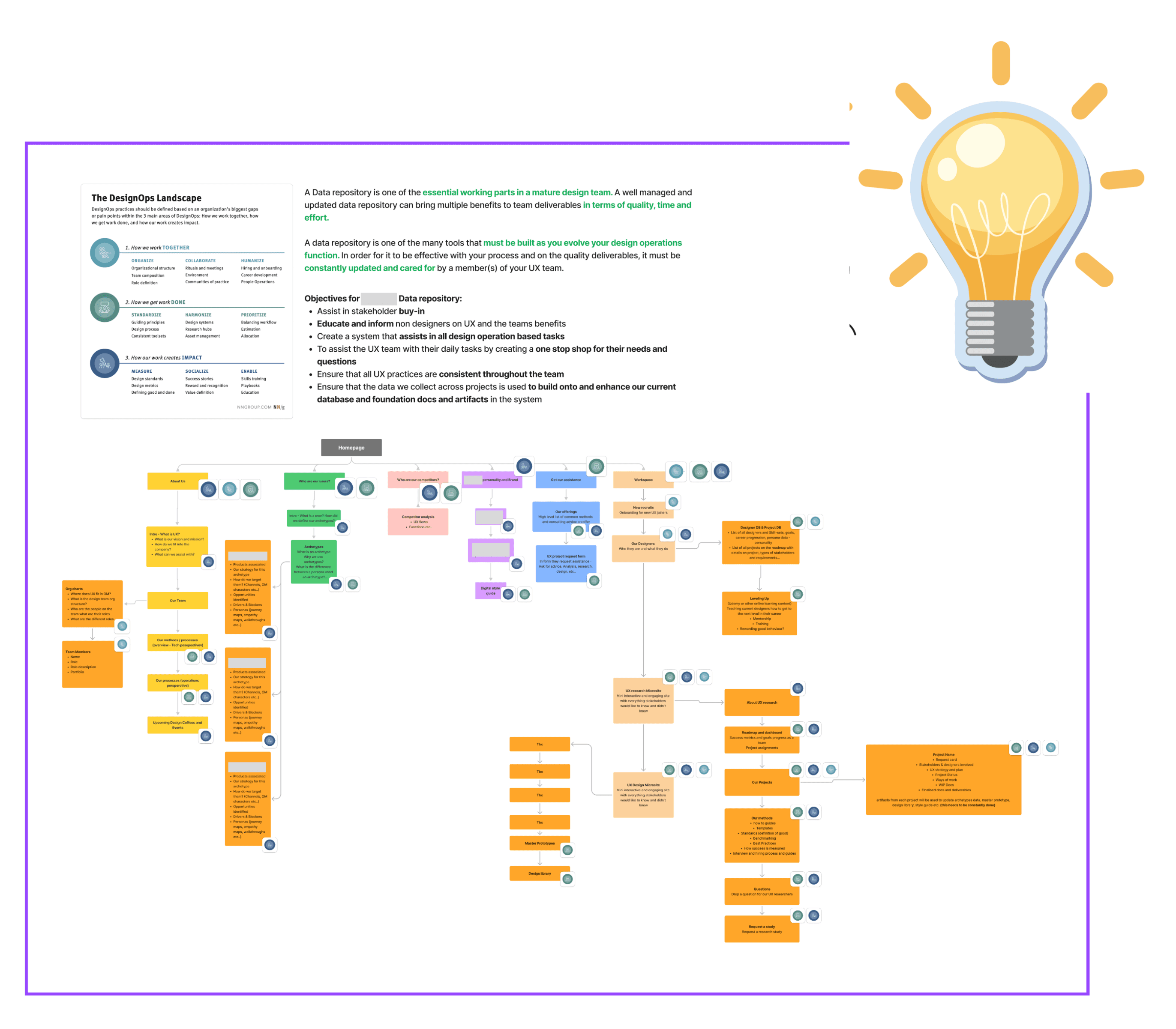
Rather than limiting the solution to a single repository, the concept evolved into a broader UX site, structured around dedicated microsites for each UX discipline. This approach allowed research to exist within a larger ecosystem, where insights could connect to foundational artefacts such as personas, journey maps, and strategic outputs.
The information architecture was designed to support both depth (detailed research documentation) and breadth (cross-functional visibility and reuse).
Rather than limiting the solution to a single repository, the concept evolved into a broader UX site, structured around dedicated microsites for each UX discipline. This approach allowed research to exist within a larger ecosystem, where insights could connect to foundational artefacts such as personas, journey maps, and strategic outputs.
The information architecture was designed to support both depth (detailed research documentation) and breadth (cross-functional visibility and reuse).
Designing for collaboration within constraints
Designing for collaboration within constraints
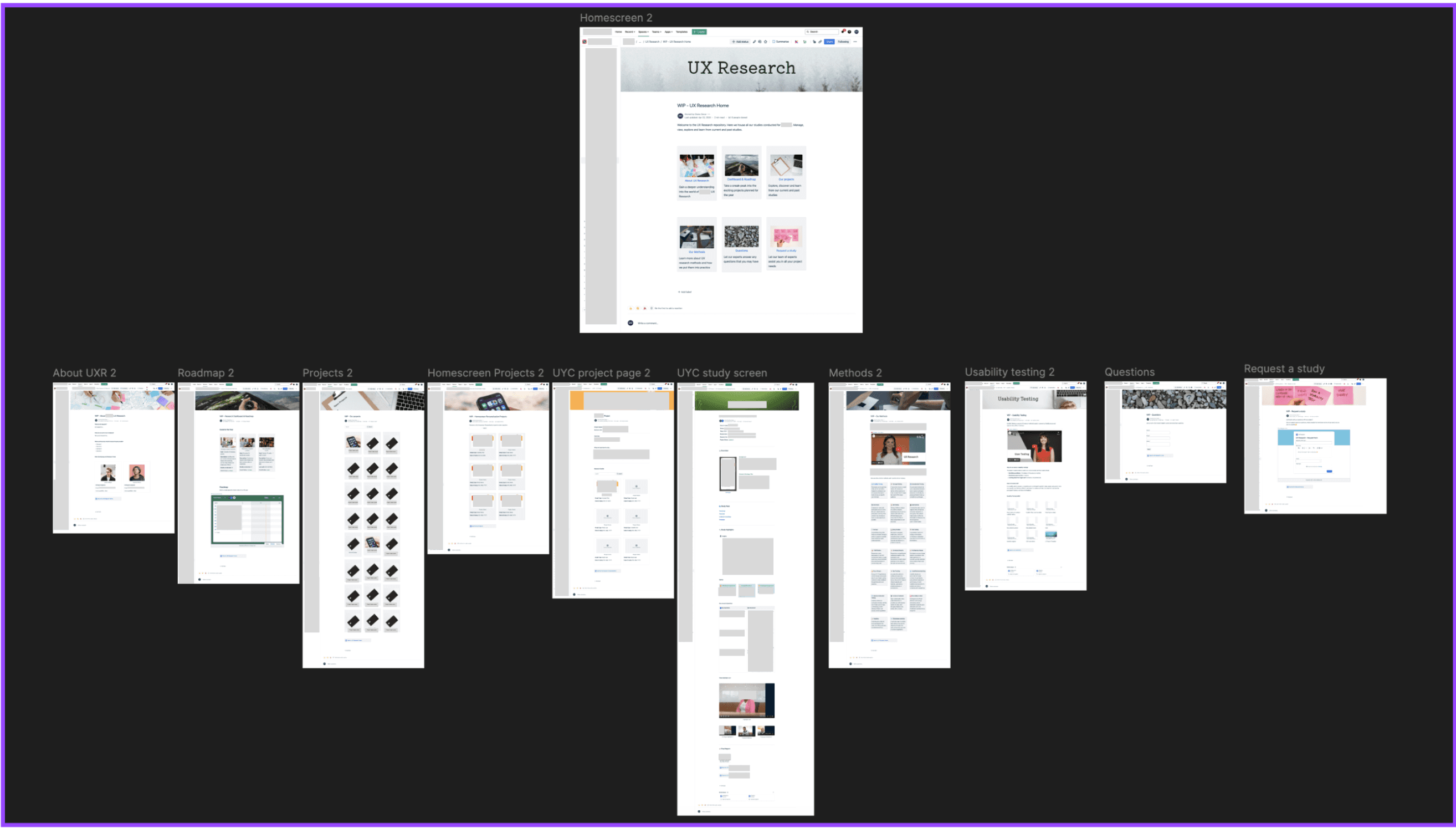
A key focus was ensuring the platform was not only functional but actively used.
The experience was designed to support collaboration and engagement by introducing stakeholder-friendly areas, including shared opportunities and spaces for interacting with research outputs. This encouraged visibility, participation, and reuse of insights across teams.
Confluence was selected due to its integration within existing workflows, despite its limitations in supporting interactive experiences. To address this, lightweight HTML and design workarounds were used to create a more structured, visually intuitive, and engaging interface that improves usability while maintaining alignment with existing tools and reducing adoption friction.
A key focus was ensuring the platform was not only functional but actively used.
The experience was designed to support collaboration and engagement by introducing stakeholder-friendly areas, including shared opportunities and spaces for interacting with research outputs. This encouraged visibility, participation, and reuse of insights across teams.
Confluence was selected due to its integration within existing workflows, despite its limitations in supporting interactive experiences. To address this, lightweight HTML and design workarounds were used to create a more structured, visually intuitive, and engaging interface that improves usability while maintaining alignment with existing tools and reducing adoption friction.
A key focus was ensuring the platform was not only functional but actively used.
The experience was designed to support collaboration and engagement by introducing stakeholder-friendly areas, including shared opportunities and spaces for interacting with research outputs. This encouraged visibility, participation, and reuse of insights across teams.
Confluence was selected due to its integration within existing workflows, despite its limitations in supporting interactive experiences. To address this, lightweight HTML and design workarounds were used to create a more structured, visually intuitive, and engaging interface that improves usability while maintaining alignment with existing tools and reducing adoption friction.
Validating and iterating the concept
Validating & iterating
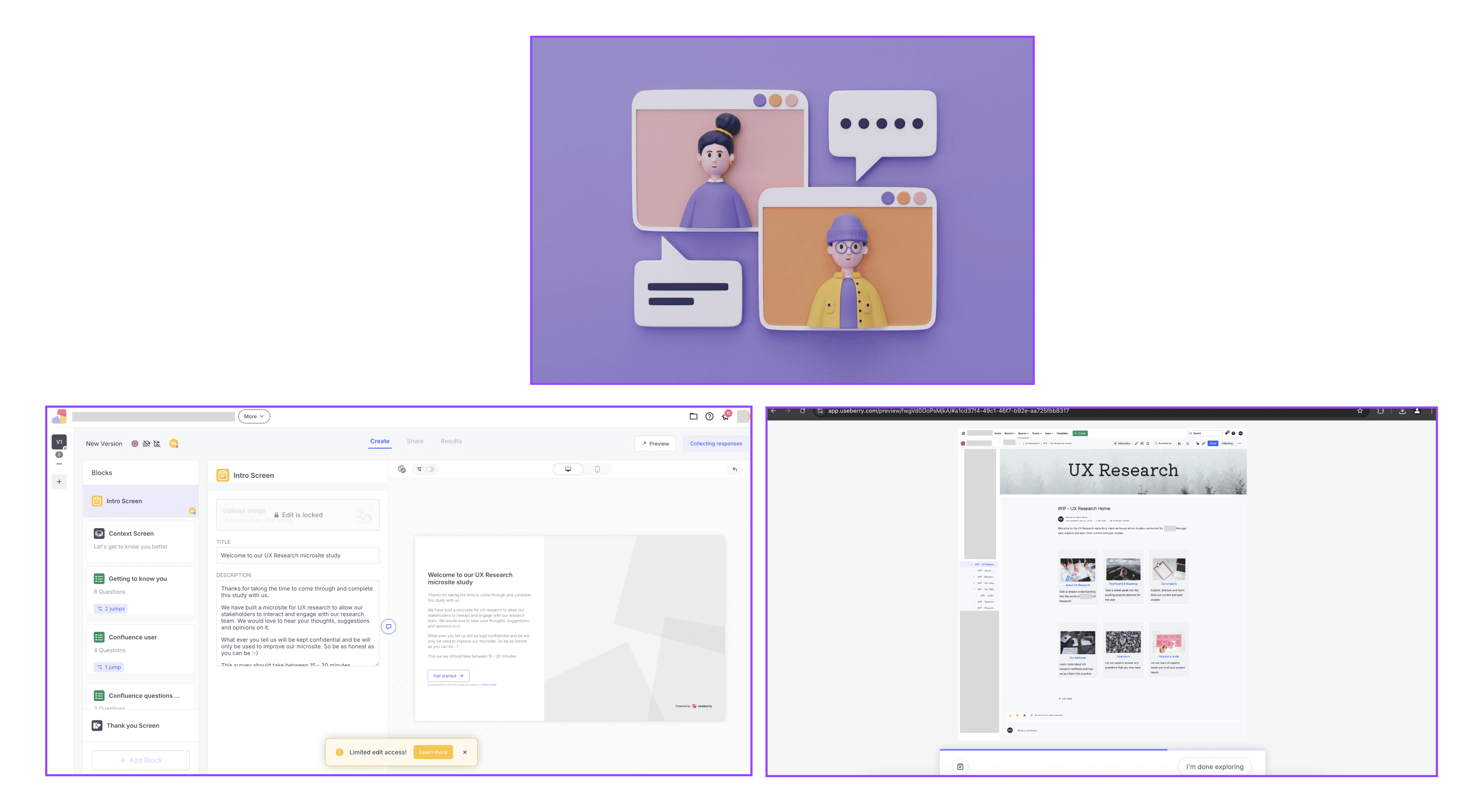
The concept was tested through remote moderated sessions and unmoderated testing using Useberry Feedback was gathered through exploratory tasks and follow-up questions to assess usability, clarity, and overall experience. Insights from testing informed iterative updates, refining both the structure and features of the microsite to better meet user and stakeholder needs.
The concept was tested through remote moderated sessions and unmoderated testing using Useberry Feedback was gathered through exploratory tasks and follow-up questions to assess usability, clarity, and overall experience. Insights from testing informed iterative updates, refining both the structure and features of the microsite to better meet user and stakeholder needs.
Outcome
Outcome
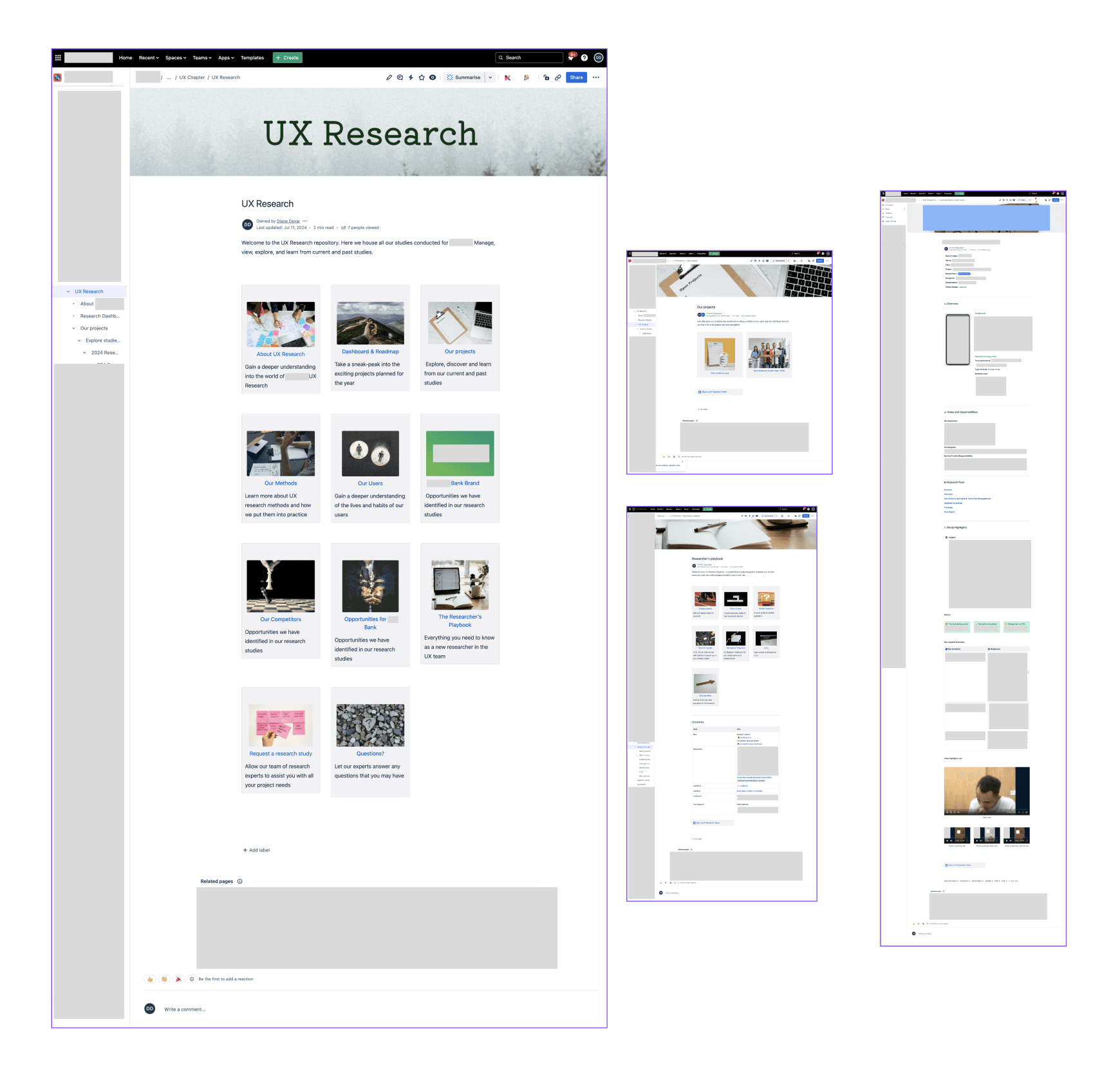
The final solution delivered a structured and scalable UX research platform, transforming how research was stored, accessed, and utilised across the organisation.
By moving from a static repository to a connected UX ecosystem, research became more visible, accessible, and easier to reuse across projects. This shift ensured research moved from being stored to being actively used as a driver for design and decision-making.
The microsite was well received and saw strong adoption, with teams actively engaging with the platform as a central source of truth for research insights. It also established a stronger foundation for collaboration and knowledge sharing, enabling research to feed into broader UX and business outputs.
🧠 Reflection:
This project reinforced the importance of looking beyond the initial brief to uncover underlying organisational needs.What began as a request for a repository evolved into designing a system that makes research more visible, reusable, and accessible across teams.
It also highlighted the importance of balancing usability with adoption to ensure solutions align with existing workflows while improving how teams work. In hindsight, introducing clearer governance earlier would have further strengthened the platform’s long-term sustainability.
The final solution delivered a structured and scalable UX research platform, transforming how research was stored, accessed, and utilised across the organisation.
By moving from a static repository to a connected UX ecosystem, research became more visible, accessible, and easier to reuse across projects. This shift ensured research moved from being stored to being actively used as a driver for design and decision-making.
The microsite was well received and saw strong adoption, with teams actively engaging with the platform as a central source of truth for research insights. It also established a stronger foundation for collaboration and knowledge sharing, enabling research to feed into broader UX and business outputs.
🧠 Reflection:
This project reinforced the importance of looking beyond the initial brief to uncover underlying organisational needs.What began as a request for a repository evolved into designing a system that makes research more visible, reusable, and accessible across teams.
It also highlighted the importance of balancing usability with adoption to ensure solutions align with existing workflows while improving how teams work. In hindsight, introducing clearer governance earlier would have further strengthened the platform’s long-term sustainability.
The final solution delivered a structured and scalable UX research platform, transforming how research was stored, accessed, and utilised across the organisation.
By moving from a static repository to a connected UX ecosystem, research became more visible, accessible, and easier to reuse across projects. This shift ensured research moved from being stored to being actively used as a driver for design and decision-making.
The microsite was well received and saw strong adoption, with teams actively engaging with the platform as a central source of truth for research insights. It also established a stronger foundation for collaboration and knowledge sharing, enabling research to feed into broader UX and business outputs.
🧠 Reflection:
This project reinforced the importance of looking beyond the initial brief to uncover underlying organisational needs.What began as a request for a repository evolved into designing a system that makes research more visible, reusable, and accessible across teams.
It also highlighted the importance of balancing usability with adoption to ensure solutions align with existing workflows while improving how teams work. In hindsight, introducing clearer governance earlier would have further strengthened the platform’s long-term sustainability.